A day digging at the Ness of Brodgar…

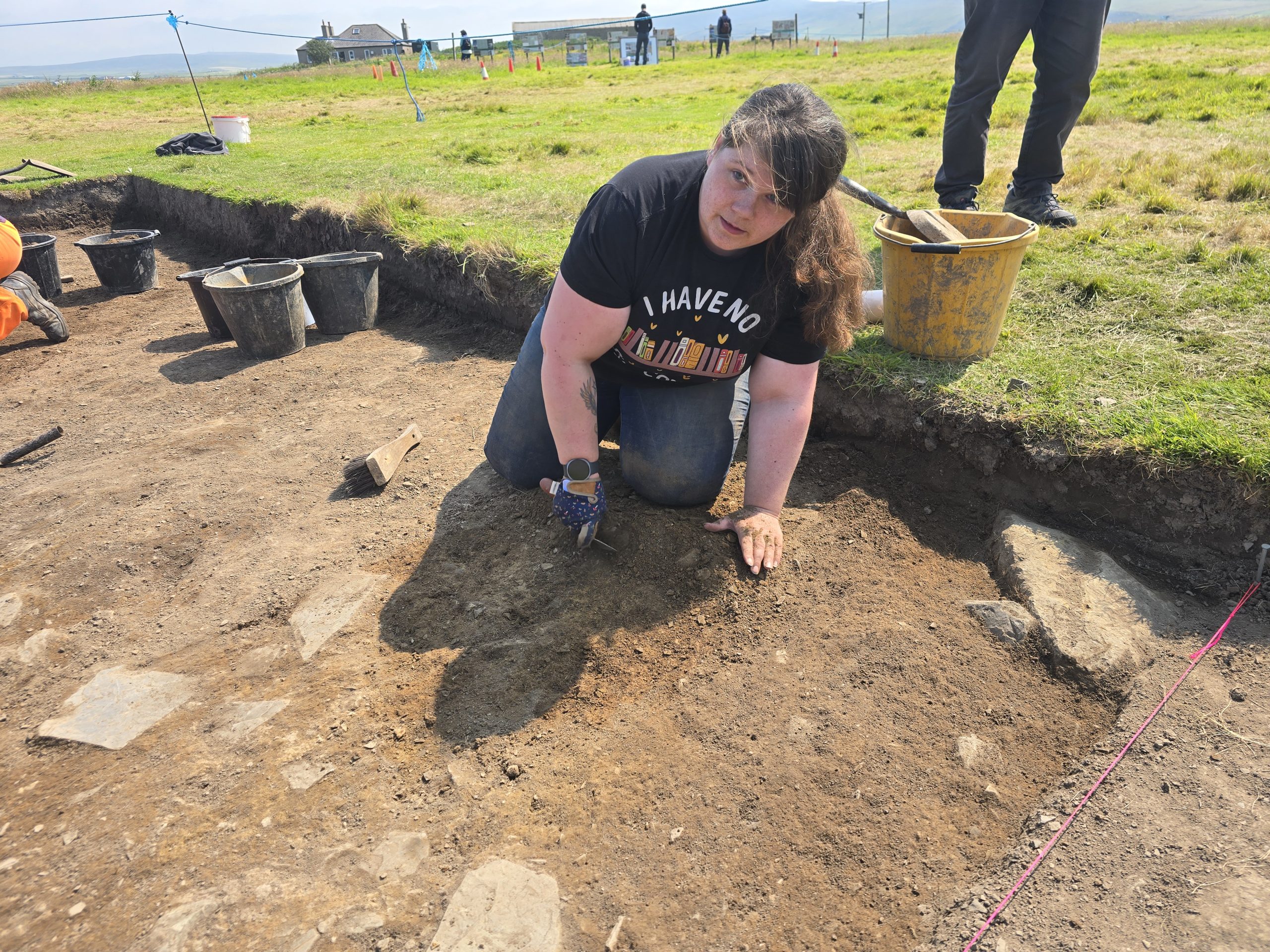
The Orcadian’s Alex Ross swapped her pen for a trowel as she took part in the “dig of a lifetime” at Brodgar, last week. The archaeologist-turned-journalist turned her hands to both professions to share a remarkable behind-the-scenes report on the latest Ness of Brodgar dig.
The fresh efforts in Stenness come after the discovery of a geophysical anomaly at a previously unexcavated section of the site.
Things move quickly in archaeology. So much so that the picture of what this new site may be has changed dramatically, just days after Alex’s visit. For the latest updates, see our story on page 6 of this week’s newspaper.
It has been two years since I last picked up my trowel and took to the trenches of an archaeological excavation.
Before moving to Orkney I was a commercial archaeologist, working for MOLA Headland and Archaeological Solutions.
I came to Orkney to study a Masters in Archaeology at UHI, and worked for several years with ORCA — Orkney’s own commercial archaeological company, as a relief archaeologist.
I had never had the opportunity to dig at the Ness of Brodgar, so it was an absolute privilege to be welcomed to join the excavation for a day this summer.
The world heritage site has reopened for a four-week investigation following the discovery of a mysterious anomaly by Time Team geophysics expert Dr John Gater. The excavation is a joint effort between the Ness of Brodgar Trust and Time Team, who are filming the dig for a documentary.
It has been a cause for much excited speculation, with some theorising that an ancient stone circle could be hidden beneath the ground.
It is hoped that this fresh dig may provide answers.
When I arrived on site, it was a thrill to see the work that has already been done.
The excavation trench has been divided into quadrants so that each area can be approached individually.
In the north-east quadrant, lies a row of large stones, and this is believed to be the oldest feature currently in the trench. A water pipe was found running along the extent of it, which needed to be removed in the first week.
The stones continue around the three quadrants that are currently uncovered, but it is the north-east quadrant that is the clearest, with the stones appearing more rubbly in nature elsewhere.
Across the quadrant ard marks have been found — cuts in the ground formed by a stone tool often used for ploughing. This is evidence of the area potentially being used for agricultural purposes.
Extremely little has been discovered so far during the excavation in the way of “finds”, but this in itself is extremely interesting. The Ness of Brodgar is notoriously full of artifacts, and a site in such close proximity being so sterile raises plenty of questions.
I spent the day in the south-east quadrant of the trench, where there were the most visible “rubbly” stones.
The stones do follow the shape of the rest of the structure — an almost circular feature around nine metres wide. In addition to this rubble, there is potentially a smaller circular structure seemingly attached to the main feature. What this is will become clearer as the excavation continues.
To begin my day excavating, I was first asked to help mattock down part of the quadrant, helping bring the quadrant to one level. This helps safely expose the archaeology below, and is far faster and more efficient than troweling when removing larger amounts of earth. The team took it in turns of mattocking, shovelling and emptying the wheel barrows as they filled.
Once the site was level, myself and several others lined up along one edge and started cleaning back the quadrant.
Cleaning is when you use a trowel to scrape off a thin layer of soil, removing debris and soil that may have been shifted or muddied by people walking over the area, or wind blowing dust and dirt over the area. This can hide and distort any archaeology below.
As you clean, any archaeological features pop out. You can normally see features through changes in the soil — a different colour and texture, a change in inclusions such as gravel or number of stones. These differences can at times be glaringly obvious, but more often they are nearly invisible to the untrained eye.
The constant sun and warmth of the summer can be both a blessing and a curse. Though picturesque, the light can make it hard to see the subtle changes in colour, and the warmth instantly dries out the soil, which also can cause any changes to be camouflaged.
Water is sprayed on the site to rehydrate the soil, helping increase the visibility, but in weather like what we currently have, this can last mere minutes.
Overcast with light drizzle was often my preferred weather for excavating previously.
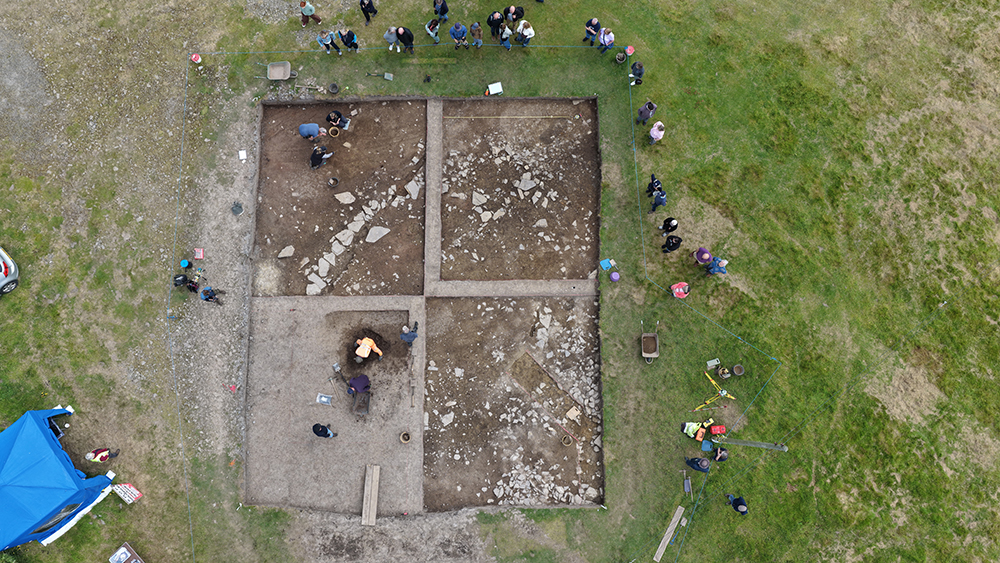
Where I cleaned in the top left corner, edging the centre of the overall trench, the edge of a feature could be seen, its dark grey soil strongly contrasting with the yellow hues of the earth around it — which due to its location in the centre of the circle has the potential to be an extremely interesting once excavated.
As I moved further back with my cleaning the texture of the soil changed, with a slightly more red compact soil overlying the yellow below. Later in the day I removed this soil — known as a deposit — with a mattock.
Though little more than an inch thick at its deepest, dragging a sharp mattock over it was enough to quickly lift off the soil exposing the yellow below in a controlled and efficient way. Done correctly, can leave it with a clean finish than only needs a miniscule amount of cleaning off with a trowel afterwards.
Cameras and recording is happening around us as we work, filming for Time Team’s documentary and Patreon, where people can pay to follow along with the progress of the site as it happens, and with exclusive interviews and behind the scenes of the dig.
Throughout the day, records are written and photos with scales are taken, so that each aspect of the dig is recorded. No part of an archaeological site should not be recorded, with all the paperwork later helping paint the picture of the site when it is later analysed.
The bulk of the paperwork is likely to be completed the day after my visit, however. This day of cleaning the quadrant serves the purpose of showing archaeologists where to focus. Where needs to be dug? What’s showing up here that isn’t elsewhere in the trench? What is most likely in this quadrant to answer the question of what this anomaly is?
It is the day after my visit that these features will begin to be excavated — sections of the archaeology removed to show the profile of what’s there, and what potentiality lies below it.
Archaeology is far more of a science than many people realise. Every time archaeologists break ground we need to be able to justify it — does this benefit our understanding of the site? Does the damage to archaeology — for every archaeological evasion is destructive in nature — benefit our understanding of the period and wider context enough to justify it, or can it be left in situ, undisturbed for later generations.
It is currently unclear what age the site is — but currently it is expected to be either early Neolithic, or early Bronze Age.
It will be over the coming weeks that the nature anomaly will start to be revealed, as more of it is uncovered, and the archaeology excavated and investigated.
It is the post excavation side of an excavation that is often the most lengthy, time consuming and costly. Soil is analysed, finds cleaned and catalogued, paperwork digitalise and sorted, a hive of activity behind the scenes that many of the public never see. This is the phase that the main Ness of Brodgar excavation has now entered.
These also have costs associated with them, so anyone who wishes to help donate towards this can do so at https://www.nessofbrodgar.co.uk/donate/