
Loos could cost £1.7m Brodgar study claims

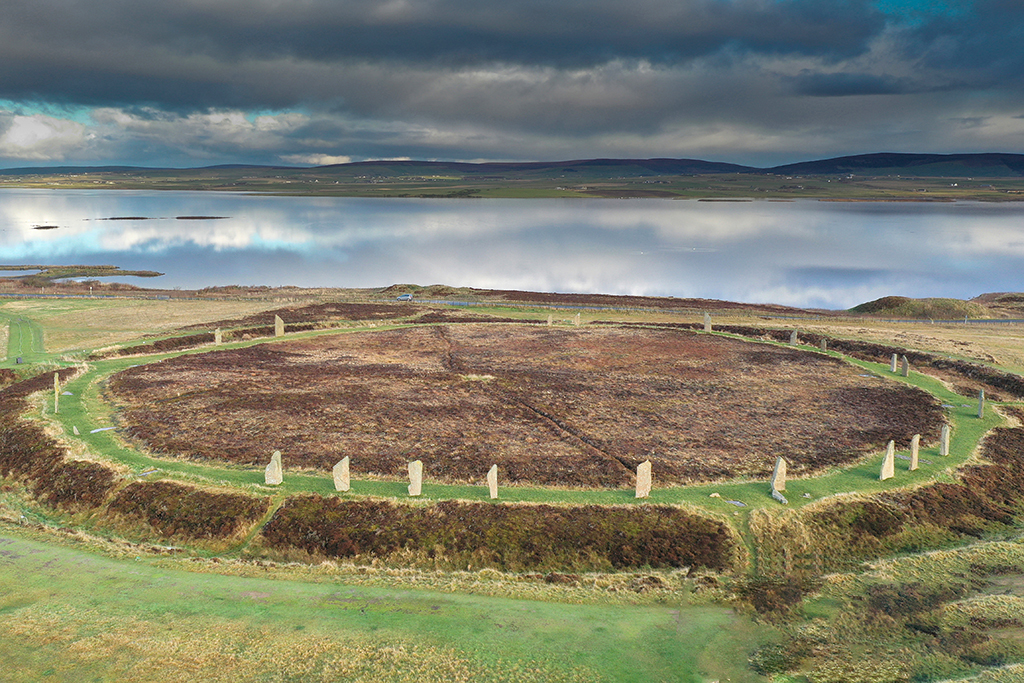
Building much-needed toilets at the Ring of Brodgar could cost as much as £1.7 million, a study has revealed.
Growing tourist traffic has shone a harsh spotlight on the Neolithic attraction in recent years, with calls for toilets there becoming ever more urgent.
A feasibility study has been done but the “costs and practicalities” of installing loos were “considered prohibitive,” site manager Historic Environment Scotland (HES) has said this week.
This comes as Freedom of Information (FOI) requests by The Orcadian have revealed the results of a study co-commissioned by Orkney Islands Council into the matter, as well as the cost of cleaning up the muck at Brodgar.
Proposals for some kind of facility at the stone circle have been on the cards since at least 2019, but there has been little progress since then.
In the meantime, OIC is continuing to hire a contractor to remove waste from the Brodgar car park — an effort which has so far cost £3,000 over the past five years.
Plans to put temporary toilets in place were put to councillors in 2023, but it was felt the matter needed more discussion.
In 2024, it was instead recommended that permanent facilities be placed in the car park by 2027 (although it was noted that the target was unlikely to be met).
At the same time, a feasibility study was carried out, which has now been obtained by The Orcadian.
The investigation, by HRI Munro Architects and OIC, found there were problems with putting in permanent toilets — and all the other options too.
From the various conservation areas covering Brodgar, to the lack of facilities for disposing of waste from temporary toilets, the plans have hit one blockage after another.
Building toilets hooked up to electricity, water supplies, and sewage treatment facilities could cost around £1.7 million, the study says. This would involve re-flagging the car park — which is owned by the council — and creating bus stances, all contributing to the high cost.

Even if the toilet block was built, the study says the council doesn’t have the staff to maintain it, meaning there would be added running costs of between £25,000 and £35,000 each year.
This option would also probably involve discharging the treated sewage into either Harray Loch or, more likely, Stenness Loch.
Looking at “off-grid options,” like a changeable cassette toilet, could be much cheaper — possibly saving £600,000, when compared to the earlier design.
But a lack of waste disposal facilities in Orkney, or contractors willing to handle the waste, made this option tricky to pursue, according to the study.
An “incineration toilet” has even been considered, but the technology was found to be “not appropriate” for a location with high visitor numbers.
What about temporary toilets? Although a couple of Portaloos suddenly appeared and just as quickly disappeared last month, in an apparent stunt to highlight the ongoing problem, the study suggests that maintaining such facilities in the longer term would also face waste disposal issues.
OIC’s building standards department has also said that there is a limit — of 28 days in a year — for how long temporary toilets could be in place at any one spot. The planning department has also indicated that a “temporary style solution is unlikely to be supported.”
The 2024 study, which cost OIC and HES £10,000, concluded without a clear way forward to clear-up the messy situation.
Instead, three recommendations were made:
- Revisit the feasibility of a mains-connected toilet.
- Look into a mobile toilet bus, or lorry unit, which could be based in the Brodgar car park (plus finding a waste disposal solution).
- Explore other sites with an existing mains and septic system, and use “visitor management measures” to reduce “undesirable toileting behaviour” at the Brodgar car park.
In a progress report to councillors in June last year, a way forward still had not been found.
“It is clear that there is not one solution that will resolve the problem that exists,” the report says.
Before any temporary measure could work, a new waste disposal facility will need to be built. The construction of such a facility should be explored in the “short/medium term,” the progress report says.
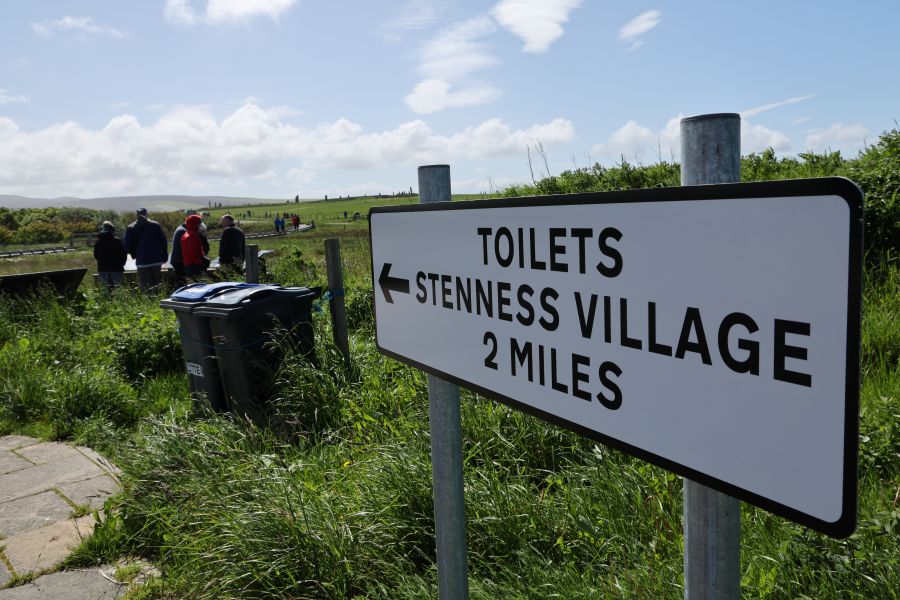
OIC identified 15 other “next steps,” including to review the impact of the signage in the Brodgar carpark, directing visitors to toilets in Stenness two miles away.
A spokeswoman for HES told The Orcadian: “The study found both costs and practicalities for installing toilets in this location were considered prohibitive.
“HES is continuing to work in partnership with OIC to shape the long-term future of the World Heritage Site.”
In 2023, the heritage agency offered an initial sum of £4,000 towards the OIC plan to have temporary toilets at the Brodgar car park — an offer branded “insulting” by Councillor Leslie Manson, given the estimated total costs were nearly £100,000.
In the same meeting, Councillor Manson suggested that Brodgar’s toilet problem was one that has been talked about for too long, with little to no action to show for it.
“The proposal was set to take place over three years and at the time we indicated we would have been happy to explore increased support for subsequent years, given our budgets run financial year to financial year,” the HES spokeswoman said.
In an interview with The Orcadian last month, Destination Orkney’s Martin Fleet said the toilets at Brodgar had to be a top priority.
He believes visitors could be charged for using such a facility, and that there will be ample examples of how this could work.
Mr Fleet said: “It’s achievable but we must try and focus on the solutions rather than keeping on talking about it year after year. Rather than saying planning is an issue or this is an issue and so on.
“Other destinations have done it, so let’s look to those who have been successful and cherry-pick the best solutions from destinations and let’s make it happen.”