
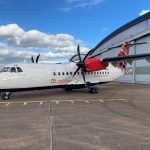
‘Island flights are a lifeline, not a convenience’ — cross-party group call for aviation strategy

Liam McArthur flew to Canada and back for the same price as flying between Kirkwall to Edinburgh.
The £700 it cost Mr McArthur to fly return between Edinburgh and Toronto to watch his son Tom compete for Scotland in the Commonwealth Powerlifting Championships was the same as the cost of the return flight between Kirkwall and Edinburgh the politician paid in May after his re-election.
The eye-watering cost of flights to and from Orkney was a recurring theme he said from constituents, as he and a cross-party group of politicians made the case for a regional aviation strategy in the face of a “managed decline” of services in Orkney and across the Highlands and Islands.
In the face of sustainability fears, service reductions, sky high ticket costs and rising concern on the overall direction of travel, politicians backed the development of a strategy to support a resilient, sustainable and accessible air network.
Orkney MSP Mr McArthur led the debate in the Scottish Parliament which drew widespread support from a number of parliamentarians, including Kristopher Leask.
Speaking in Holyrood on Thursday, Mr McArthur said he appreciated that Loganair and the aviation sector are facing “enormous challenges” and the reasons behind high costs are often multi-layered.
However, he had noted that there had been a willingness from Loganair to cross-subsidise between routes or between busy and less busy periods of the year in the past — a willingness that is no longer there.
“For island communities, those flights are truly lifeline services and, as such, should reflect the needs of those communities,” said Mr McArthur, speaking in parliament.
“However, over recent years and across the Highlands and Islands, that has increasingly not been the case.
“We have seen a decline in service levels and a gradual consolidation of routes that has been described by the Highlands and Islands Transport Partnership (HITRANS) as a ‘narrowing by commercial attrition'”.
“Loganair makes the fair point that it is a commercial business and the financial pressure of maintaining some routes is becoming more and more unsustainable, but it feels as if there is a process of managed decline, with service levels dropping, ticket prices rising and islanders being priced out of travelling on those routes, despite air discount support.”
The recent reinstatement of flights linking the Northern Isles with Inverness highlighted the fragility of the region’s air travel.
A £1.3 million funding package from the Scottish Government and Highlands and Islands Airports Limited enabled the reinstatement of the full flight schedule, which will restart on October 26.
Mr McArthur said the funding was “very much a short-term response to a longer-term problem”.
“As Loganair has made crystal clear, the risk is that, come next March, without a further injection of subsidy, those routes will be pulled again.”
He welcomed moves already under way to review how the network operates but he stressed that the process will require leadership from Scottish ministers to ensure reform does happen and happens at pace.
He welcomed the work of stakeholders, including HITRANS, for developing options, drawing on models from France, Norway, Greece and Corsica.
“However, it must not be a case of lift and shift,” continued Mr McArthur.
“Whatever model is applied in Scotland and the Highlands and Islands must reflect our specific needs and circumstances, but we should take encouragement from the fact that other countries are operating successful, sustainable models. We are not starting with a blank canvas.”
The recent winter timetable issued by Loganair contained the consolidation of routes from the Northern Isles to Edinburgh, with an overall reduction of between 10 and 15 per cent, according to Mr McArthur.
“That follows a familiar pattern of merging services, combined with not overnighting aircraft in the islands, that has reduced or removed entirely the ability of people in the islands to make a day-return journey between the northern isles and the central belt.
“Those routes are vital for access to essential services, but they are also economically significant. Routinely merging flights limits the economic growth potential of our islands, makes regional investment more costly and reduces resilience, competitivity and opportunity.”
The development of a regional air strategy led and driven forward by government was backed by a cross-party group, all of whom who spoke of the absolute lifeline nature of flights for their communities.
Vic Currie, Reform MSP for the Highlands and Islands, said that reliability and consistency was one priority that was achievable.
He also suggested that a dedicated fund for a standby aircraft and crew system based in the region could help negate the impact of mechanical faults in the day’s schedule.
Furthermore, he said that enhancing the public service obligation framework, with strict reliability clauses to ensure that the operator meets minimum performance thresholds, would add accountability should performance levels fall below-par.
Donald MacKinnon highlighted that a Loganair flight from Edinburgh to Stornoway on Saturday would cost just short of £300, while a Loganair flight on the same day to Southampton would cost £178.
Even with the air discount scheme, which enables islanders 50 per cent off, air travel is out of reach of many islanders, said Mr MacKinnon.
Meanwhile, Highlands and Islands Green MSP and Orkney Islands councillor Kristopher Leask viewed air travel as being part of a “fractured transport system that delivers for some and not for others”.
“Across the region, we are seeing higher prices, the reducing of services and the hanging uncertainty of whether routes will still be operated or not.
“We have a system that lacks co-ordination, integration and a focus on delivering for communities.”
Cabinet secretary for transport, Stephen Flynn recognised the vital need for flights for island communities and highlighted government support for key routes.
He also highlighted that the air discount scheme is in 20th year, which saw a government commitment of £15 million to fund last year.
He said he and the transport committee were committed to exploring these issues, including “consideration of whether a regional air strategy for the Highlands and Islands is required and what it would do to end some of the current constraints and utilise some of the powers that we have.”
Mr McArthur also welcomed news that a potential solution to enable those with mobility issues to access the Islander aircraft may now be close at hand.