

Protocol dispute surrounds case of suspended council chief
Councillors told 'not to discuss any aspect' of Oliver Reid's 'special leave'

There is no end in sight, no answers, and no timeline for when the chief executive of Orkney Islands Council (OIC) might return to his work.
Six months on, The Orcadian understands that the process relating to Oliver Reid’s “special leave” has been delayed.
This is understood to be due to a dispute on whether the local authority has followed established protocols, amid an ongoing investigation.
Nationally agreed guidelines require Scottish local authorities to follow strict frameworks, if they decide to take disciplinary action against a chief executive, or question their competence.
Internal documents obtained by The Orcadian — and revealed in August — suggested that OIC may not have followed the policies surrounding the concerns over the chief executive.
This appears to be at the centre of the ongoing saga, which has now cost the taxpayer thousands of pounds.
It is now six months since chief executive Mr Reid was sent home, after he arrived at his work at School Place on Monday, May 25.
He was not invited to any of the meetings to discuss his “special leave”, though the guidance requires that he would be involved in the process.
The frameworks dictate that a council leader — in this case Councillor Heather Woodbridge — is to inform a group of councillors about the allegations against the chief executive.
Before Mr Reid was suspended, OIC leader Councillor Heather Woodbridge and deputy leader Councillor Sandy Cowie met with five of their colleagues — councillors Gwenda Shearer, Rachael King, Mellissa Thomson, Steven Heddle and convener Graham Bevan.
However, it seems the elected members weren’t informed of the full details behind the top official’s subsequent removal.
OIC has refused to comment on why it is not following the established frameworks, created by the Scottish Joint Negotiating Committee for Chief Officials.
Most details on the removal of Mr Reid — including a spiralling legal bill — have only emerged following freedom of information (FOI) requests.
It was through FOI requests that The Orcadian revealed how the plans to remove Mr Reid were made just the week prior to his suspension.
However, the authority is refusing to share a large amount of information.
This includes a report that was discussed by councillors the last time “Governance Arrangements” were on the agenda of the full council in June.
When asked for internal emails about the suspension, OIC has recently refused to provide anything other than responses to media queries.
The Orcadian has appealed this, but the limited information in response did include some interesting details.
When the newspaper and BBC Radio Orkney published detailed reports on the suspension of Mr Reid in July, OIC officials sought legal advice.
Amid worries that the story would make national headlines, a transcript was made of the BBC’s Around Orkney programme and sent to internal lawyers at School Place.
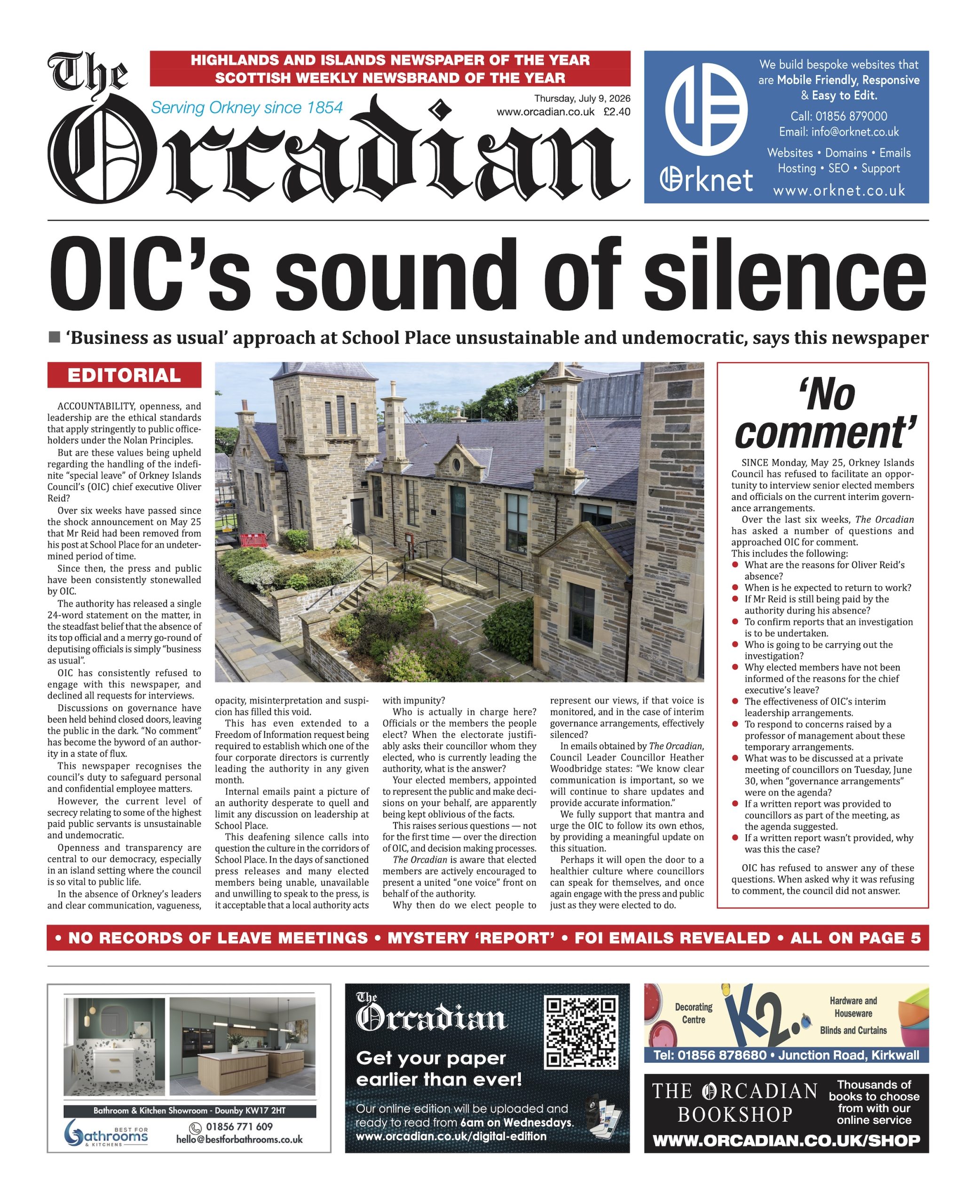
Meanwhile, a briefing note was sent to councillors on July 8 on the local media characterising Mr Reid’s “special leave” — a term usually reserved for unforeseen emergencies, personal crises or bereavement — as a suspension.
It states: “Both BBC and The Orcadian contacted the council last week to advise that, based on information gathered through their own research, they intended to characterise the absence in this manner.”
The document reiterated that OIC had not altered its official statement, claiming Mr Reid was on a period of “special leave.”
This is despite OIC offering not one evidenced reason as to why the media would be wrong to describe the absence as a suspension.
The briefing note continues: “The council has consistently advised that the chief executive is on a period of special leave and has not communicated any further detail regarding his absence.
“All council communications have been consistent using this terminology, and this position remains unchanged.”
In line with advice they had received soon after the chief’s removal, councillors were told not to say anything about this situation to anyone.
“Elected members are requested not to discuss any aspect of the chief executive’s period of special leave with employees, members of the public, or representatives of the media,” the document continues.
“This is a highly sensitive and confidential matter. Any comment, regardless of intent, could risk the inadvertent disclosure of confidential information or contribute to speculation regarding matters that are not in the public domain.
“It is therefore essential that all enquiries are handled consistently and that members refrain from making any comment beyond the council’s published position.”
The revelations come amid a private meeting on leadership at OIC on Wednesday, November 4.
Councillors agreed that Mr Reid would not take on the role of returning officer at the May 2027 local government elections.
Corporate director for enterprise and infrastructure, Gareth Waterson, will be serving in the important position instead.